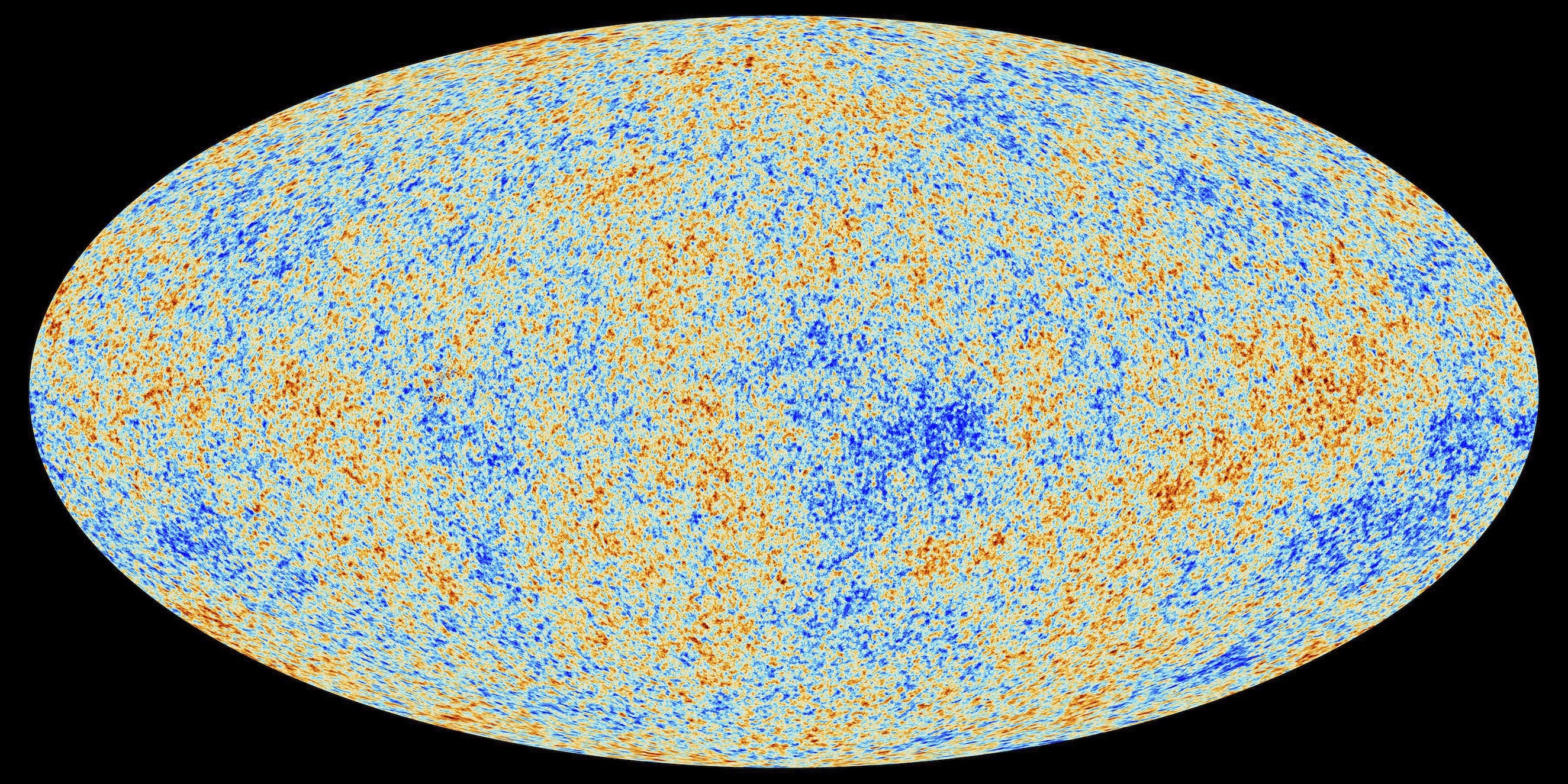
Point a sensitive enough antenna at any patch of empty sky — even the darkest desert night — and you will hear a faint microwave hiss. It comes from every direction, in every season, at all times of day. It is not from your antenna. It is not from Earth. It is not from any star or galaxy you can see.
It is a photograph of the universe when it was 380,000 years old.
Pigeon Poop and a Nobel Prize
In 1964, two Bell Labs engineers named Arno Penzias and Robert Wilson were trying to build a very quiet radio antenna in Holmdel, New Jersey. There was a persistent hiss in their receiver that they could not get rid of. They checked the wiring. They cooled the amplifier. They climbed inside the antenna's horn and scrubbed off the pigeon droppings.
The hiss remained. It came from every direction in the sky.
About 60 kilometres away at Princeton, a group of physicists had just predicted exactly such a signal — the leftover radiation from the Big Bang. Penzias and Wilson had accidentally discovered the strongest piece of evidence for cosmology in the 20th century. They received the Nobel Prize in 1978.
What We Are Actually Seeing
For the first 380,000 years after the Big Bang, the universe was so hot and dense that light could not travel freely. Photons kept bouncing off free electrons like light through fog. The universe was opaque.
Then it cooled below about 3,000 K. Suddenly electrons could stick to protons and form neutral hydrogen atoms. The fog lifted. For the first time, light could travel in a straight line — and it has been doing so ever since.
That first release of light is what we detect today as the cosmic microwave background, or CMB. It is the moment the universe became transparent.
Why Microwaves and Not Visible Light? When it was emitted, the CMB was hot, visible-spectrum light — roughly the colour of red-hot iron. But the universe has been expanding for 13.8 billion years, and expansion stretches out light waves. The wavelengths have been stretched by a factor of about 1,100. What was red light became infrared. Infrared became microwaves. Today, we see it at about 2.7 K (just three degrees above absolute zero).
The Tiny Bumps That Became Everything
The CMB is astoundingly uniform — the temperature is the same to about one part in 100,000 in every direction. But it is not perfectly uniform. Those tiny variations, one hundredth of a percent, were the seeds of everything. Slightly denser regions had slightly more gravity. Over billions of years they collected more matter, collapsed, and became galaxies, stars, planets, and us.
Every galaxy you see traces back to a tiny quantum ripple in that CMB temperature map.
COBE, WMAP, Planck
Three satellite missions have mapped the CMB in ever finer detail: COBE (1989), WMAP (2001), and Planck (2009). Each one produced a temperature map of the entire sky, and each one has shaped modern cosmology.
From those tiny bumps, cosmologists have worked out that the universe is 13.8 billion years old, geometrically flat, and made of roughly 5% ordinary matter, 27% dark matter, and 68% dark energy. Almost every 'well-known fact' about the universe comes from analyzing this one image.
The Beautiful Part
Cosmology is the only science where the past is not lost. Every night the universe hands you its baby picture, encoded in a faint microwave glow that has been travelling for nearly 14 billion years. Point an antenna up. You are seeing the beginning of everything.