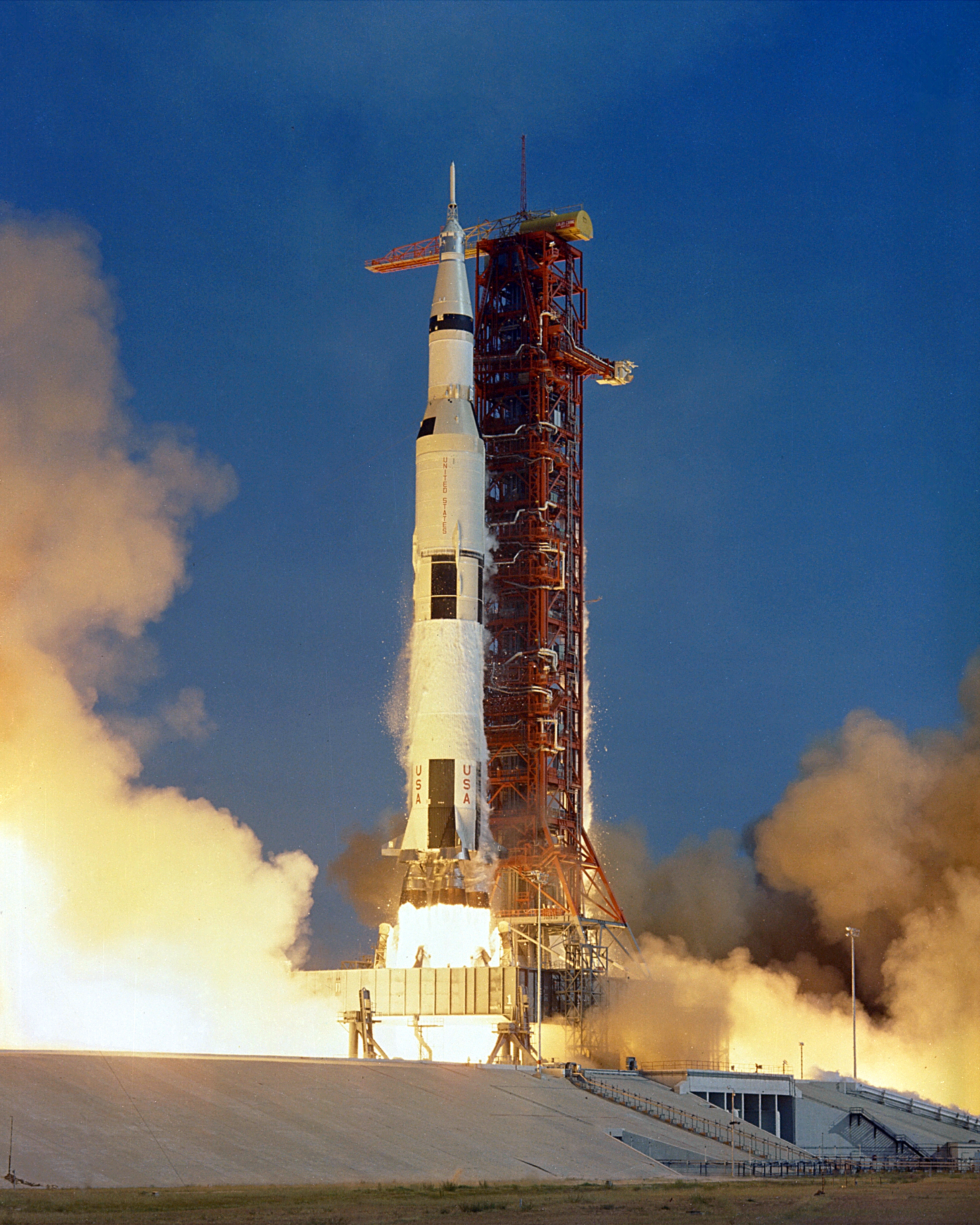
In 1969, the Saturn V rocket weighed about 2,965 tons at liftoff. Roughly 88% of that — over 2,600 tons — was propellant. What actually reached the Moon was around 140 tons: the Apollo capsule, lunar module, service module, and the fuel needed to steer them home. The rest of the vehicle — thousands of tons of tanks, engines, and structural aluminium — was thrown away in pieces during the first eleven minutes of flight.
That ratio is not a design flaw. It is a mathematical certainty. And it was worked out sixty-six years before Apollo 11 by a nearly-deaf Russian schoolteacher named Konstantin Tsiolkovsky.
Newton in a Vacuum
A rocket does not push against air. There is no air where it is going. So how does it accelerate? The same way a person on ice pushes off from another person: it throws mass out the back very fast, and by Newton's third law, the rocket goes forward. That is it. That is the entire principle.
The mass being thrown out the back is the burned propellant — extremely hot gas exiting the nozzle at 2 to 4 kilometres per second.
Tsiolkovsky's Equation
In 1903, Tsiolkovsky wrote down the math. Stripped of the physics language, it says:
Your final speed depends on two things: how fast the exhaust leaves the back, and what fraction of your rocket was propellant at liftoff.
The exact form is Δv = v_e × ln(m₀ / m_f), where m₀ is the mass at liftoff, m_f is the mass after the propellant is gone, and v_e is exhaust velocity.
The Exponential Problem
The ln in that equation is the killer. It means that doubling your target speed does not double your propellant — it roughly squares your rocket. Want to go twice as fast? Your rocket needs to be several times bigger. Want to go four times as fast? Now it is dozens of times bigger.
For a single-stage chemical rocket to reach orbital velocity (about 7.8 km/s), you would need roughly 90% of your liftoff mass to be propellant. To reach escape velocity (11.2 km/s, needed to leave Earth's gravity entirely), it climbs closer to 96%. There is essentially no chemical rocket that can do this from a standing start on Earth as a single stage. Which is why nobody does.
Staging: Throwing Away the Rocket
The clever trick is staging. As you burn propellant, you also carry the weight of the tank that used to hold it — dead weight you no longer need. Drop the empty tank as soon as it is empty, revealing a smaller, lighter rocket underneath.
Saturn V had three stages. Falcon 9 has two. Each time you drop a stage, your rocket suddenly weighs a lot less and can accelerate much harder on what propellant remains. Without staging, chemical rockets literally cannot reach orbit.
Saturn V's first stage burned for about 2 minutes 30 seconds and was then jettisoned into the Atlantic. The second stage burned for another 6.5 minutes. The third stage did a 2-3 minute burn to reach parking orbit, then re-lit later to send Apollo to the Moon.
Why Reusability Changed Everything
Reusable rockets like Falcon 9 do not beat Tsiolkovsky's equation. The equation is a law of physics — you cannot outrun it. Reusability is an economics trick, not a physics trick. It lets you amortize the cost of the rocket over many flights, cutting the price per kilogram to orbit by roughly 10×.
The physics is exactly as harsh as it was in 1903. What has changed is that we are now willing to spend the money to beat it — and we finally stopped dropping our expensive hardware into the sea.
The Punchline
Every trip to orbit is a controlled explosion, precisely balanced against a merciless equation. Burn faster, get lighter faster, throw away what you no longer need — or you do not go. That is the whole game, and it has not changed in 123 years.